Step-by-Step Origami for Everyone
Origami911 teaches traditional origami and our own original designs one clear step at a time. Every diagram is drawn by us, every model is checked fold by fold in our crease simulator, and every model page has a free printable step sheet. Start with the paper boat, the fortune teller or the paper crane.

Start with these
More easy origami →New to origami? Fold the paper boat or the fortune teller first: both take under ten minutes with simple folds. Then learn the square base and fold the crane. Every model page shows difficulty, step count, time and paper size at the top, so you always know what you are starting.
 Paper boat●●●●● Very easy · 9 steps · 5 min
 Paper fortune teller●●●●● Very easy · 11 steps · 7 min
 Classic dart paper airplane●●●●● Very easy · 8 steps · 5 min
 Origami cat face●●●●● Very easy · 9 steps · 5 min
 Origami911 Two-Piece Heart Clasp Ring●●●●● Easy (small and a little fiddly) · 12 steps · 8 min
 Origami crane●●●●● Intermediate · 13 steps · 15 min
Browse by category
184 models in 19 sections. Every model page shows the difficulty, step count, folding time and paper size before you start.
 Action & ToysModels that spin, flap, pop and snap: fortune tellers, boats and poppers.24 pages →
 Paper AirplanesDarts, gliders and stunt planes, with trimming tips for longer flights.27 pages →
 AnimalsCats, dogs, foxes, elephants and more, from very easy faces to full figures.25 pages →
 BirdsThe crane, the swan, owls, penguins, flamingos and more.16 pages →
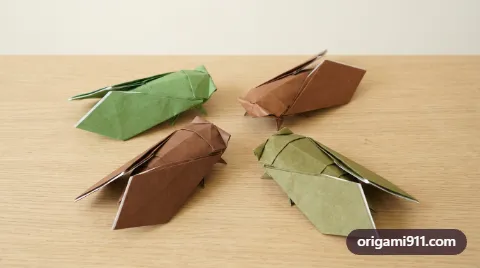 InsectsButterflies, ladybugs, beetles and other small folded creatures.10 pages →
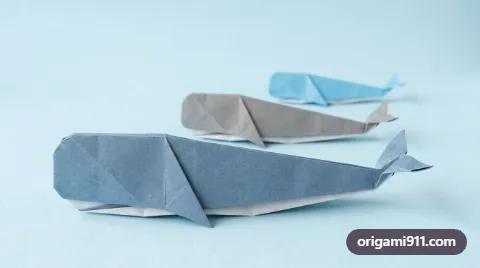 Sea CreaturesFish, whales, jellyfish, sharks and starfish.12 pages →
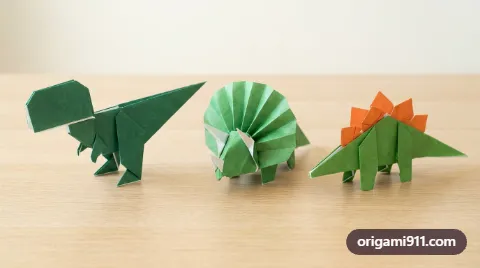 DinosaursT. rex, triceratops, stegosaurus and a flying pterodactyl.5 pages →
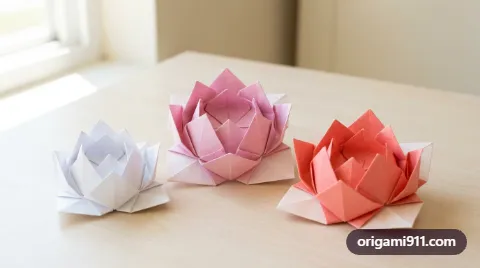 Flowers & PlantsTulips, lotus, roses, leaves and a whole bouquet.10 pages →
 Boxes & ContainersMasu boxes, lidded boxes, cups, bowls and a paper wallet.13 pages →
 StarsLucky stars, five-pointed stars and Christmas stars.4 pages →
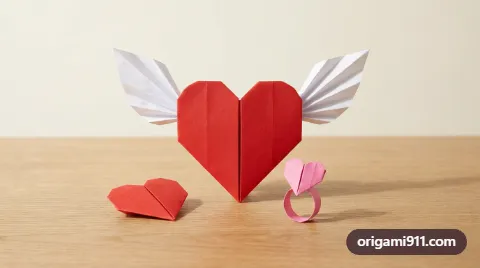 HeartsHeart rings and winged hearts for cards and gifts.2 pages →
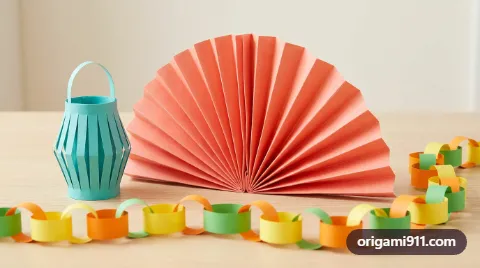 DecorationsLanterns, fans, garlands and wreaths to hang up.6 pages →
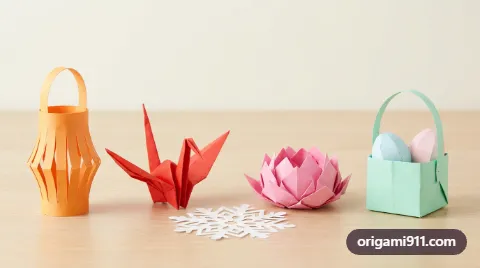 HolidaysSeasonal models for Halloween, Christmas, Easter and more.25 pages →
 Napkin FoldingTable napkin folds for dinners, parties and weddings.10 pages →
 Modular OrigamiSimple units locked together into balls and polyhedra.3 pages →
 KirigamiFold-and-cut snowflakes, paper doll chains and pop-up cards.3 pages →
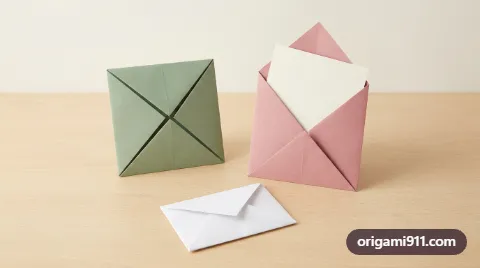 Envelopes & Letter FoldsFold a letter into its own envelope, no glue needed.3 pages →
 BookmarksCorner bookmarks that slip over the page, including a monster.3 pages →
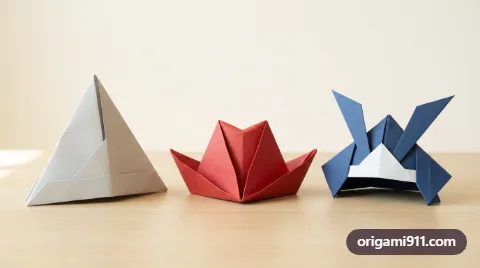 WearablesHats, helmets, rings, masks and bow ties you can put on.11 pages →
Our original designs
109 models designed by our own team, each checked fold by fold in our crease simulator before it goes live. You will not find them anywhere else.
 Origami911 Slot-Wing Foam Glider●●●●● Moderate (cutting) · 11 steps · 45 min
 Origami swallow●●●●● Intermediate · 16 steps · 30 min
 Origami911 Reed Sleeve Whistle●●●●● Very easy · 9 steps · 5 min
 Three-Strip Lizard●●●●● Easy (3 straight cuts) · 15 steps · 15 min
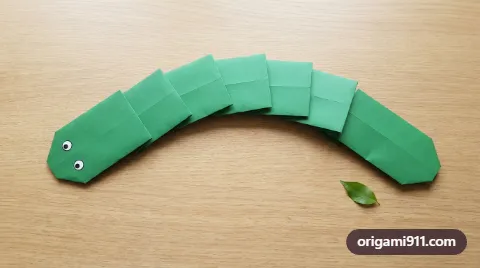 Origami Wave Caterpillar●●●●● Easy · 14 steps · 15 min
 Origami911 House-and-Garage Pop-Up Card●●●●● Easy · 9 steps · 15 min
 Origami monster bookmark●●●●● Easy · 10 steps · 6 min
 Origami heart with wings (Pocket-Wing Heart)●●●●● Easy to intermediate (one collapse and two small pleats) · 13 steps · 15 min
Coming up: seasonal origami
All holidays →Models for the next holidays on the calendar, with ideas for classrooms, parties and gifts.
 Halloween origamiEasy Halloween origami step by step: black cats, treat bags, candy boxes, hats and spooky garlands, with printable diagrams and color ideas for 2026.
 Diwali OrigamiEasy Diwali origami for 2026: a paper lotus, LED-lit lanterns, a door garland, fans, lucky stars, a sweets box and a gift envelope, with step diagrams.
 Thanksgiving origamiEasy Thanksgiving origami for 2026: napkin folds, place cards, treat boxes, a thankful star jar and garlands, with step-by-step diagrams and autumn colors.
 Hanukkah OrigamiEasy Hanukkah origami for 2026: lucky stars, lanterns, garlands, gelt envelopes, gift boxes and napkin folds in blue, white and silver, with step diagrams.
Learn the folds and bases
All 82 learn pages →22 technique pages and 11 base pages, each with its own step diagrams. Learn a fold once and you will recognise it in every model.
Printables and tools
Fold away from the screen: every model has a one-page step sheet, and teachers get ready-made lesson plans and worksheets.
Pick a model by difficulty
| Difficulty | Models | Good first picks |
|---|---|---|
| ●●●●● Very easy | 55 | Origami dog face, Origami fox face, Bow tie napkin fold |
| ●●●●● Easy | 98 | Paper snowflake, Origami ship, Lotus napkin fold |
| ●●●●● Intermediate | 31 | Origami magic circle, Origami911 Slot-Wing Foam Glider, Origami911 Kite-Pair Horse |
More ways to browse
About Origami911
Start here
Origami is the art of folding a single sheet of paper into a shape, usually with no cuts and no glue. You need nothing more than a square of paper and a flat table. Our pages are built for complete beginners: each step has its own diagram, a short instruction in plain English and a tip for the most common mistake. Diagrams show the coloured and white sides of the paper exactly as yours will look, so you can check your work after every fold.
If a model uses a base you do not know yet, the step links to our origami bases guide. Learn four bases, the kite, square, waterbomb and bird base, and you can fold most traditional models.
Why our diagrams are different
Every Origami911 diagram is drawn by our own team, step by step, with consistent symbols: a dashed red line for a valley fold, a dash-dot teal line for a mountain fold and curved arrows for movement. Each step is checked against the one before it, so no fold is skipped and no flap appears from nowhere. Every model is also checked fold by fold in our crease simulator before it goes live. We never put text or numbers inside the drawings, so they work for any reader.
We publish only traditional folk models, folded for generations and owned by no one, and original designs made by our own team. We never copy a designer's model or another site's diagrams.
Free printable step sheets
Every model page includes a free printable step sheet with all the diagrams on one page, in A4 and US Letter. Teachers can print one per pupil, parents can keep a sheet next to the paper drawer, and anyone can fold away from a screen. The sheets are free for personal and classroom use.
How we rate difficulty
Each model is rated from one to five dots. One dot means a few simple folds that a five-year-old can follow with help. Two dots adds a base or a fold such as the squash fold. Three dots means a model built on the bird or frog base, with petal folds and reverse folds. Four and five dots are for longer models that need precise folding. The step count and an estimated folding time for a first attempt sit next to the rating on every page.
Key facts
- Every Origami911 diagram is drawn by our own team, step by step.
- We publish only traditional folk models and our own original designs.
- Every model page has a free printable step sheet in A4 and US Letter.
- Each model is rated for difficulty from one to five dots, with step count and folding time.
- Four bases, kite, square, waterbomb and bird, unlock most traditional models.
Frequently Asked Questions
What is the easiest origami for beginners?
The paper boat, the fortune teller, the paper cup and the cat face. Each uses only simple valley folds and takes under ten minutes on a first try.
What paper do I need for origami?
Square origami paper, 15 cm (6 in), is ideal: it is thin, holds a crease and is coloured on one side. Printer paper trimmed to a square works for most models; our guide shows how to make a square from A4 or Letter paper.
Are the instructions on Origami911 free?
Yes. Every page, diagram and printable step sheet is free for personal and classroom use.
Who draws the origami diagrams?
Our own team draws every diagram and writes every step. We never copy diagrams from books or other sites.
Why is the site called Origami911?
911 is the name of our family of free learning sites. Origami911 is the origami member of that family.
Can I use the step sheets in my classroom?
Yes. Print as many copies as you need for your pupils. Our printables section also has lesson plans, worksheets and templates.
What are Origami911 original designs?
They are models designed by our own team, such as the Spiral-Heart Rose and the Kite-Pair Horse. Each one is checked fold by fold in our crease simulator before we publish it, and each has the same step-by-step diagrams and free step sheet as our traditional models.
Drawn by us
Every diagram is drawn by our own team with the same symbols on every page, and no text inside the drawings.
Checked fold by fold
Each model is checked fold by fold in our crease simulator, so no step is skipped and no flap appears from nowhere.
Traditional or our own
Only traditional folk models and our original designs. Read our editorial policy.